
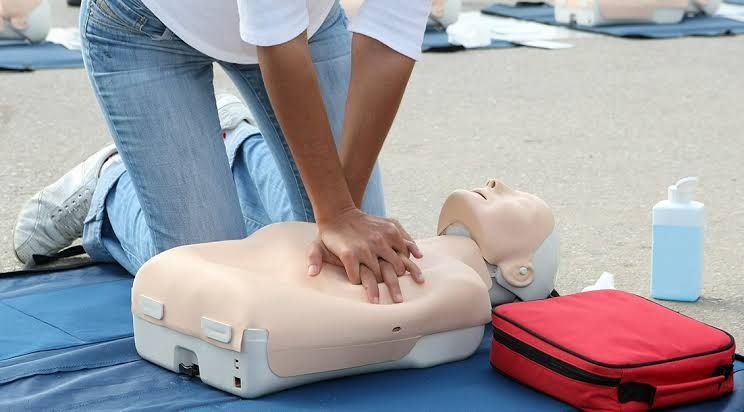
There is something oddly different about CPR training once the practice manikin is lying on the floor in front of you. Reading about chest compressions is one thing. Hearing the timer beep, kneeling down, and suddenly realizing that every second matters feels completely different.
A recent CPR training experience connected with IEMSWord brought that feeling back. The room was fairly ordinary, the kind of training space with plastic chairs, a table pushed against the wall, and equipment that had clearly been used many times before. Nothing dramatic. Still, the atmosphere changed as soon as the practical session started.
That is probably what makes CPR training useful. It takes something people generally hope never happens and makes it feel a little less unfamiliar.
What actually happens during CPR training?
Most CPR training includes a quick explanation part coupled with practical work. People learn to recognize cardiac emergencies, call for help, start performing chest compressions, and make use of AEDs.
Practicing tends to be easier to remember than theory. After performing some chest compressions on a dummy, people begin to feel more comfortable moving their hands properly. Yet, there is still some uncertainty. Initially, compressions are performed tentatively because no one wants to “hurt” the patient. Trainers emphasize that in case of cardiac arrest it is much more important to be efficient rather than to show excessive caution.
That lesson stays with people.
Is CPR training difficult for beginners?
Not really, although the physical part can be tiring. CPR training is designed for ordinary people, not just doctors, nurses, or emergency workers. Someone with no medical background can learn the basic sequence during a single practical session.
The harder part is usually staying calm and remembering what comes first. In a stressful situation, people can freeze or start looking around for someone more qualified. CPR training helps reduce that instinct by giving participants something specific to do.
There is also a little awkwardness at first. Kneeling beside a manikin and counting compressions out loud can feel silly. Five minutes later, nobody seems to care much.
Why does hands-on practice matter so much?
Hands-on practice matters because CPR is a physical skill. Knowing that compressions should be performed in the center of the chest does not automatically mean hands will land in the right place during an emergency.
During training with IEMSWord, repeated practice makes small details easier to remember. Elbows need to stay reasonably straight. Compressions need enough depth and a steady rhythm. The body has to be positioned properly instead of hovering awkwardly over the manikin.
One thing that stands out is how quickly fatigue appears. Proper compressions are harder than they look in videos. After a while, shoulders start working, breathing gets heavier, and concentration slips a bit. That is useful to experience in training, because real emergencies are rarely neat or convenient.
It also explains why CPR is often performed by more than one person when help is available. Switching rescuers can keep compressions effective.
How long does CPR training usually take?
The duration of the course may vary depending on the type of course and certification, but it can be concluded in a few hours in some basic CPR classes. Certain courses may include CPR along with AED and first-aid training, which will increase the duration of the session.
The duration is not as important as the practicality of the program. It would not be enough if the program consisted of talking for the whole time with hardly any time for practice.
The training provided should allow for errors. It may seem unimportant, but it is not the case. A person may forget the sequence of steps that need to be taken in an emergency, or might hesitate while using the AED.
What makes CPR training with IEMSWord worth remembering?
The useful part is not simply learning a certification checklist. It is the change in confidence that happens after several attempts. At the beginning, the whole process can feel like a string of instructions. Check responsiveness. Get help. Start compressions. Use the AED. Keep going.
After practice, those steps become more connected.
IEMSWord's CPR training can be viewed in that practical way rather than as just another certificate to add to a file. The value is really in having gone through the motions before they are ever needed. Nobody knows exactly how they will react when someone collapses nearby. Training cannot guarantee calmness, but familiarity probably helps.
There is another detail worth mentioning. CPR is not about looking impressive or performing perfectly. It is about doing something useful quickly while professional help is on the way. That distinction makes the training feel much more realistic.
The purpose of CPR training is quite simple, whether in schools, workplaces, families, community groups, or anyone else. It provides the average person the beginning point to act in an unusual situation.